
A buyer's vetting checklist for choosing a custom streetwear manufacturer — tech packs, sample proofing, fabric weight, decoration mapping, labeling and small-run economics at MOQ 30, written from what a full-custom OEM factory actually delivers.
Streetwear Clothing Manufacturers: 6 Checks Before You Commit
Most supplier evaluations fail not at the price stage but at the sample stage — the point where a factory's actual process meets your artwork. These six checks are the ones that decide whether a streetwear clothing manufacturer can execute your brand's spec, framed around what a full-custom OEM program actually has to show you.
Dongguan Qianjing Clothing Design Co., Limited runs a full-custom OEM operation for B2B buyers: hoodies, tees, jackets, pants and sweaters made to the buyer's brand, in made-to-order runs that include custom main labels, care labels, hang tags and packaging. That scope matters for the checklist below, because each of the six checks corresponds to a step the factory either controls or hands off — and a hand-off is where a streetwear drop loses its spec.
How the factory reads your tech pack
A tech pack is only useful if the factory treats each field as a requirement rather than a suggestion. The concrete test is simple: send a spec that fixes several variables at once — silhouette, colorway, size grading and decoration placement — and see whether the reply separates what is confirmed from what is proposed.
For a streetwear program, the fields that most often drift are the ones that define the look: oversized drop-shoulder proportions, the exact fabric construction, and where a graphic or embroidery sits. A manufacturer that restates your values back to you — rather than paraphrasing them into a generic "oversized fit" — is the one whose bulk order will match your tech pack. Ask specifically how they handle size specs: do they work from your size grading chart, or do they apply a house block and expect you to accept it?
Full-custom means production is made to your artwork, colorway and size spec. If any of those three is ambiguous at quote stage, that ambiguity does not disappear at cut-and-sew — it becomes a bulk deviation.
Sample proofing before bulk
The single most valuable sentence a factory can say to a streetwear buyer is: this was proved on a sample before bulk. Sample production is where placement, scale and registration get fixed, and where you see whether the decoration reads the way your artwork intended on the actual fabric.
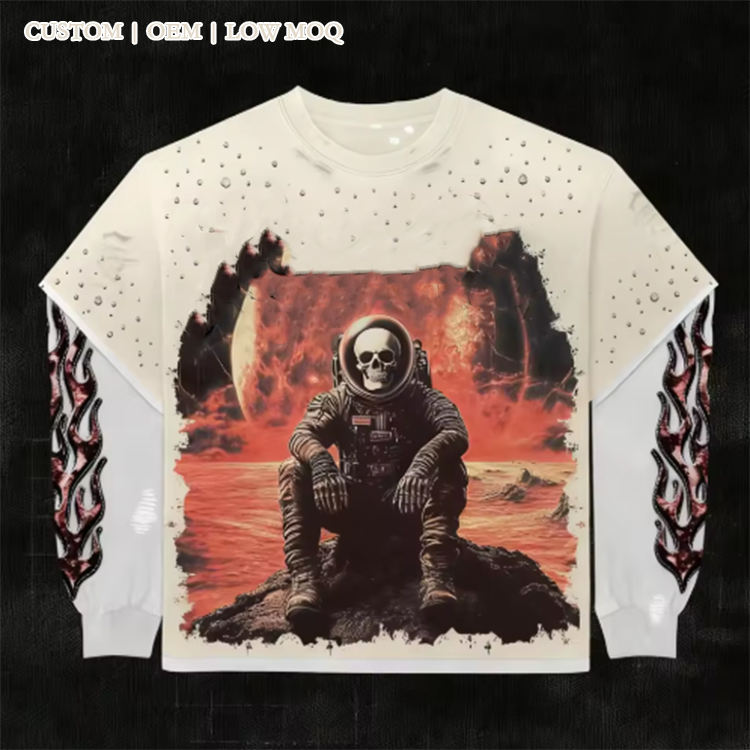
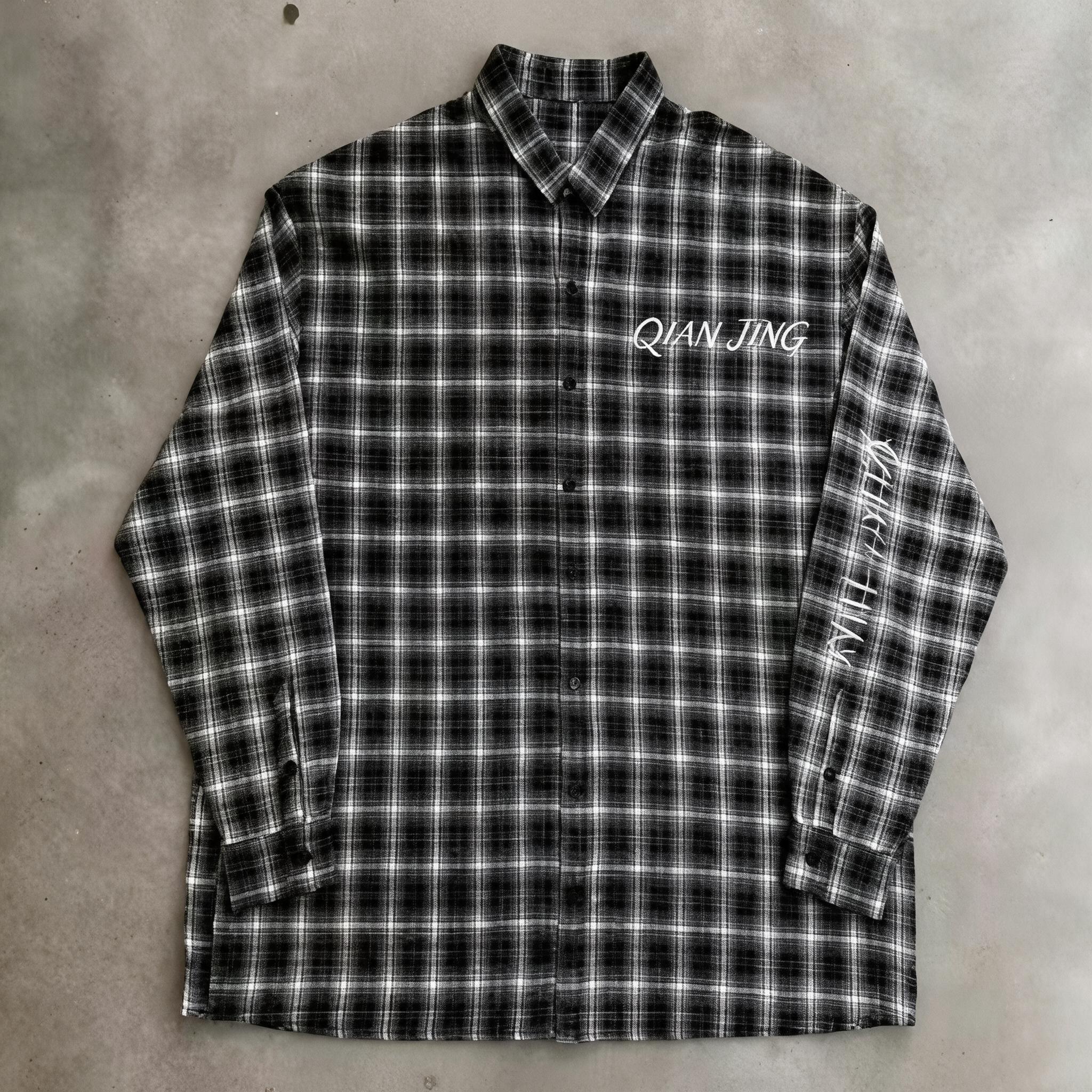
Ask for the proofing record for the specific decoration you're ordering. Two patterns are instructive. A 100% cotton waffle-knit oversized long sleeve combining DTG graphics with rhinestone decoration is proofed because DTG and rhinestone are two different application processes that must land in alignment — one printed, one set, both on the same garment. A polyester-cotton knit oversized plaid long sleeve with custom embroidery placement at chest, sleeve or back yoke is proofed because embroidery position on a plaid ground has to be checked against the pattern, not just against a measurement line.
What you are looking for from a sample: your decoration in your position on your fabric, at your size. A factory that will only show you a stock sample has not proved your program — it has shown you a neighboring one.
Fabric weight and hand-feel options
Streetwear buyers specify fabric weight because weight drives drape, opacity and how a print sits on the cloth. When you quote a program, state the weight in grams per square meter (gsm) and ask the factory to confirm the fabric it is offering against that number. Common fleece and heavy-knit references for hoodies and long sleeves sit around 450gsm, 480gsm and 500gsm — use these as the vocabulary for specifying what you want, and get the mill's stated weight on the quote, not just "heavyweight."
The reason to force this early: the same silhouette in a 450gsm versus a 500gsm fabric behaves differently under a large DTG graphic, and a waffle knit behaves differently again from a smooth jersey. Comparing two suppliers' prices without matching the fabric weight and construction is comparing two different products.
| What to put on the enquiry | Why it matters for streetwear | Evidence to ask for |
|---|---|---|
| Fiber composition (e.g. 100% cotton, polyester-cotton knit) | Chooses the hand-feel and how decoration adheres | Stated composition on the quote and on the sample |
| Weight in gsm | Controls drape, opacity, print ground | Mill's stated gsm, not a descriptive label |
| Knit structure (waffle, jersey, plaid knit) | Surface texture interacts with DTG and embroidery | Sample swatch in the actual structure |
Decoration mapping
Streetwear decoration is rarely one process. A drop might combine a printed front graphic with rhinestone accents, or embroidery across a back yoke on a plaid ground. The vetting question is whether the factory maps each decoration method to its position and to the layer beneath it — and whether it flags combinations that fight each other on your chosen fabric.
Ask for a decoration map: element, method, position, size and the fabric it sits on. Then ask what happens when two methods share a panel. A rhinestone application next to a DTG print needs an agreed order of operations and a registration plan; embroidery placement on a plaid needs a decision on whether the pattern is matched or interrupted. These are not hypothetical concerns — they are the exact decoration combinations in the two programs above, which is why both were proved on sample before bulk.
If a supplier answers decoration questions only in general terms ("we can do printing and embroidery"), you have not learned whether they can map your specific artwork. Ask for the map.
Labeling and packaging to your brand
For a B2B brand buyer, the garment leaves the factory as a product only when it carries your identity. The check is whether the factory treats main label, care label, hang tag and packaging as part of the order — made to your specs — or as an afterthought you must source separately.
Confirm each item explicitly on the quote:
- Main label — your brand mark, placement and attachment method.
- Care label — content and fiber-care wording you supply or approve, matched to the actual fabric composition.
- Hang tag — artwork, size, attachment point.
- Packaging — polybag or other format, folding, and any size-sticker or barcode requirement.
A full-custom OEM program that includes all four in made-to-order production removes a common source of delay: labels arriving after the garments are sewn. Ask, too, who approves the label artwork before it goes to print — that approval is your last cheap chance to catch a typo.
Small-run economics at MOQ 30
A minimum order quantity of 30 pieces per style changes what a first collection can look like. At this scale, the real question is not the unit price alone but what is included at that quantity: is the sample cost recoverable, are custom labels and tags priced in, and does a 30-piece run require you to simplify the decoration?
Test the supplier's small-run terms with a defined program rather than a vague enquiry. Take a single style — say the waffle-knit long sleeve with DTG plus rhinestone, or the plaid long sleeve with embroidery — fix the colorway and size spec, and ask for a full quote covering fabric, decoration, labeling and packaging at MOQ 30. Then ask what changes if you double the quantity: which cost lines move, and by how much. A factory that can itemize the difference is showing you how its small-run pricing is built; one that returns a single lump figure is not.
What the six checks add up to
A credible streetwear clothing manufacturer shows you, in documents and samples, that it can hold your tech pack, prove your decoration on your fabric, state fabric weight in gsm, map multiple decoration methods, deliver your labels and packaging, and price a 30-piece run line by line. High quality custom clothing manufacturers are distinguished less by a capability list than by how much of that list they will put in writing before you commit.
Use the checks as a scoring sheet across the factories you shortlist. The one that answers all six with evidence — and flags the ones it cannot — is the one whose bulk order will look like the sample you approved.
Questions buyers ask before committing
Is MOQ 30 per style or per order?
Confirm this on the quote. The two example programs are each stated at 30 pieces, so ask explicitly whether a mixed order of several styles at 30 pieces each is treated as one production run or several — it affects setup cost and scheduling.
Can I see my decoration on my fabric before bulk?
Ask for sample proofing of the specific combination. The two programs here were proved on sample before bulk, precisely because DTG-plus-rhinestone and embroidery-on-plaid each involve placement decisions that a stock sample cannot resolve.
How do I specify fabric weight?
State it in gsm on the enquiry and require the mill's stated weight on the quote. If you only say "heavyweight," you have given the factory room to interpret, and you will be comparing your order against a number nobody wrote down.
Are labels and packaging included in the unit price?
Ask for them as separate line items — main label, care label, hang tag, packaging — so you can see what is covered and what is extra. Made-to-order production with custom labeling should list these, not absorb them invisibly.