
A same-conditions comparison of embroidery and printing on heavyweight cotton zip-up hoodies, covering how each route behaves on 350–450g fabric, how artwork type and placement drive the decision, and how sample proofing works at MOQ 30.
Embroidery and printing are not competing versions of the same thing. On a heavyweight cotton zip-up hoodie they produce different surfaces, suit different artwork, and are proofed in different ways. This article compares the two routes under identical conditions — same fabric, same placement logic, same minimum order — so you can choose on the basis of your artwork and your program rather than on a general preference.
What this article covers
- Same garment, same conditions: the baseline for the comparison
- What embroidery does on a heavyweight zip hoodie
- What printing does on a heavyweight zip hoodie
- Artwork type as the first filter
- Placement on a full-zip body
- Sample proofing at this factory
- Decision rules
Same garment, same conditions: the baseline for the comparison
A fair comparison between custom embroidered zip up hoodies and custom printed zip up hoodies has to hold the garment constant. If one route is assessed on a 350g cotton body and the other on a lighter fleece, or if one logo is placed on a flat chest panel and the other across a bulky pocket seam, the comparison tells you nothing about the decoration method.
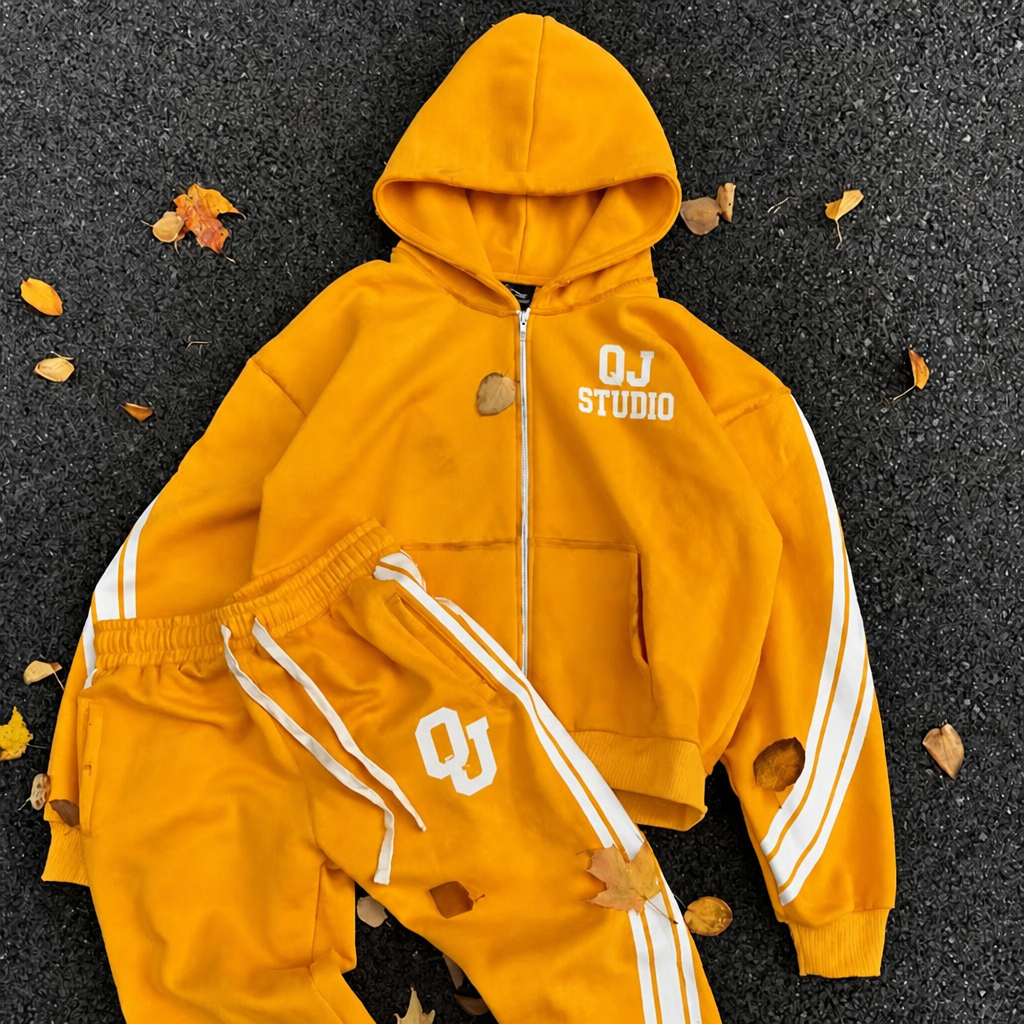
The factory's listed zip-up program is a full-zip hooded top in 100% cotton with an embroidered logo and a side kangaroo pocket, at a minimum order of 30 pieces. On the pullover side, the same factory runs a vintage-washed oversized drop-shoulder hoodie in 100% cotton with five fabric weight options — 350g, 370g, 380g, 400g and 450g — also at MOQ 30. So the fabric platform exists across a range from light-to-mid heavyweight up to genuinely heavy cotton fleece, and both decoration routes can be specified on that platform.
That is the condition to keep fixed when you compare: the same cotton body, the same weight, the same panel the decoration lands on, and the same order quantity. Everything that follows assumes that baseline. Where a statement depends on fabric weight or placement, it is tied to that factor rather than presented as a universal rule about embroidery or printing.
What embroidery does on a heavyweight zip hoodie
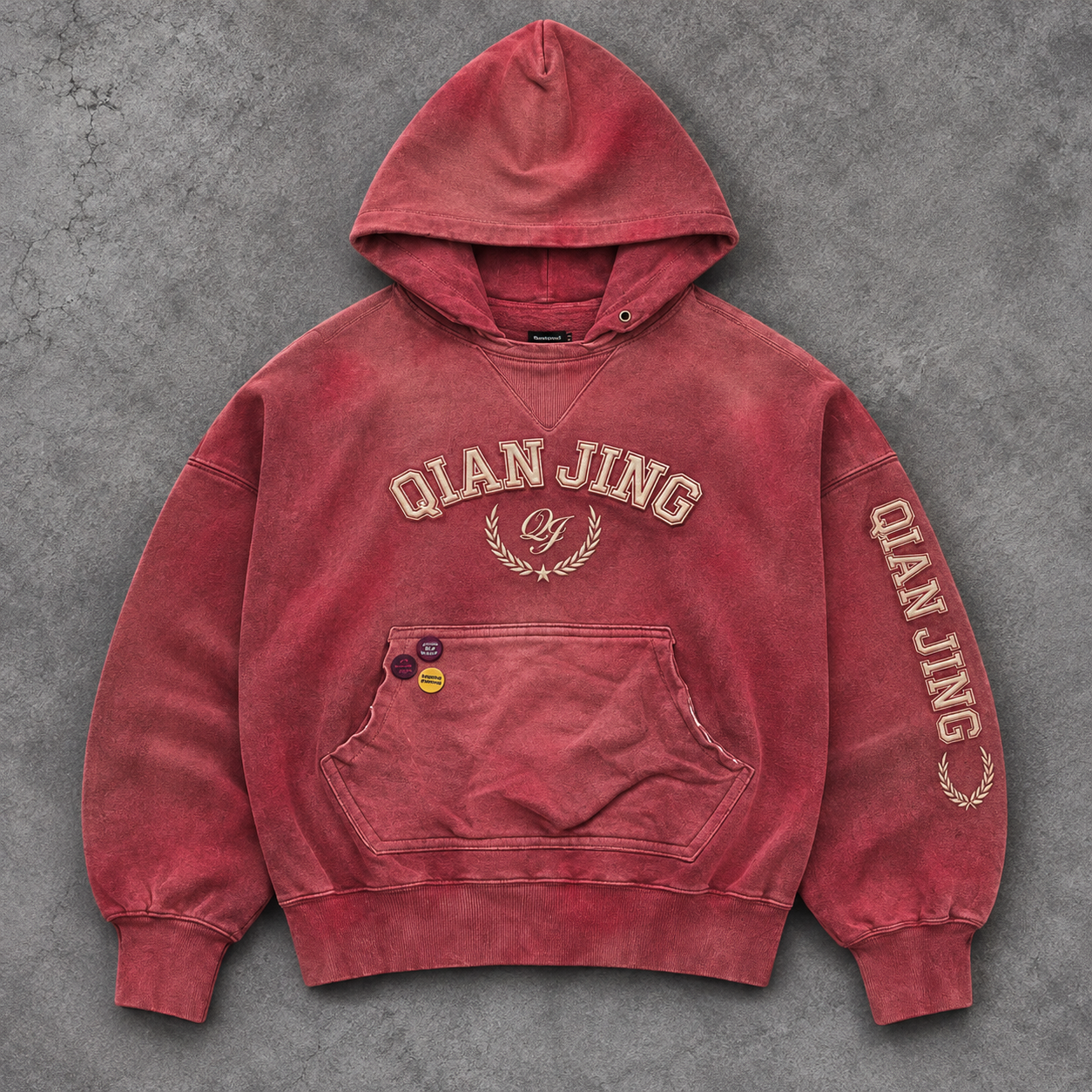
Embroidery is stitching through the fabric, so the mark sits above the surface. On a 350g to 450g cotton fleece, that produces a raised, textured logo that reads as a separate physical layer on the garment. The surface of the hoodie and the surface of the logo are not the same material, and that difference is the point: the decoration has depth and a defined edge.
The trade-off is that embroidery is built from stitches, so the artwork has to survive being translated into a stitch path. Bold shapes, blocks of color, clear lettering and logos with defined contours translate well. Very fine linework, small text, tight gradients and photographic detail are the cases where the stitch route becomes constrained — the limitation comes from the medium itself, not from a particular machine. Where the artwork is borderline, the honest move is to proof it on a sample rather than assume the result.
On the listed program, embroidery placement — chest, sleeve or back yoke — is set from the tech pack and proved on the sample. That means placement is not improvised at production; it is a specified parameter of the order, checked before bulk.
What printing does on a heavyweight zip hoodie
Printing lays ink onto the cotton surface. The mark is flat relative to the fabric — no raised profile — and the result is a graphic that can carry full color. In this article, printing means DTG: the factory applies DTG to cotton streetwear graphics programs, and its documented DTG work sits on a waffle-knit long-sleeve program, where full-color artwork is proofed on a sample before bulk and then runs from sample to production. Expect the same route on the zip-up hoodie, and confirm the DTG result on a sample of the actual hoodie fabric before bulk.
The trade-off runs the other way from embroidery. Full-color artwork, gradients, illustrated graphics and designs with many tones are native to the print route in a way they are not to stitching. What printing does not give you is the raised, stitched texture of embroidery; the ink becomes part of the fabric surface rather than sitting above it. If your brand signature depends on a tactile, stitched logo, printing will not reproduce that quality, and no amount of color accuracy changes it.
Printing also interacts with the fabric face. A heavier cotton fleece has a more pronounced surface texture than a light jersey, and artwork that relies on very fine detail is proofed on the actual body rather than judged from a file. That is precisely why the sample stage exists on the print route.
Artwork type as the first filter
Most buyers can narrow the choice before discussing price or lead time, simply by looking at the artwork file. The question is not "which decoration is better" but "what does this artwork need in order to be reproduced faithfully on this garment."
| Artwork characteristic | Embroidery tendency | Printing tendency |
|---|---|---|
| Bold logo, clear lettering, defined shapes | Suits the stitched route; raised texture reinforces the mark | Reproducible, but loses the raised profile |
| Full-color graphic, many tones, gradients | Constrained by the stitch medium | Native fit; full color on the cotton surface |
| Very fine linework or small text | Requires proofing before commitment | Requires proofing, especially on heavier fleece |
| Photographic or highly detailed illustration | Not a natural fit | Better matched to the ink route |
| Brand mark that must feel tactile | Raised surface delivers this | Flat surface; texture is not reproduced |
The table describes direction, not a verdict. Any borderline artwork should be decided on a physical sample of the actual garment.
Placement on a full-zip body
A zip-up hoodie is not a flat canvas. The front is split by the zipper, the kangaroo pocket adds a layered panel, and the seams run where a decoration can sit awkwardly if placement is not specified. This is why the factory maps decoration from the buyer's artwork file and sets embroidery placement from the tech pack rather than treating position as a detail to sort out on the line.
The practical points to settle before sampling:
- Chest placement on a full-zip front has to clear the zipper and sit symmetrically across the two panels. A mark that crosses the zipper line will break when the hoodie is worn open.
- Sleeve placement is a common choice for embroidery, where the raised logo reads clearly against the arm.
- Back yoke gives a broad, flat area that suits larger embroidered marks, and it is one of the placements the listed program specifies.
- Pocket area on the side kangaroo pocket program needs its own position call, because the pocket panel is a separate piece of fabric.
For print, the same placement logic applies, with one addition: because ink sits flat on the surface, a graphic placed across seams or a pocket edge is judged on the sample, where the fabric's response to the ink is visible. On either route, placement is a specification, not a preference — write it into the tech pack.
Sample proofing at this factory
Both routes converge at the same checkpoint: the sample. This is where the comparison stops being theoretical.
- Artwork mapping. The decoration route is mapped from the buyer's artwork file, so the file determines whether the program is set up as embroidery or print from the start.
- Placement specification. Embroidery placement — chest, sleeve, back yoke — is set from the tech pack. The same principle applies to the print route, where the graphic position is specified before proofing.
- Sample production. Embroidery is proved on a sample of the garment. On the DTG print route used for streetwear graphics, full-color artwork is proofed on a sample before bulk, and the program then runs from sample to production.
- Fabric weight check. Because the platform offers 350g, 370g, 380g, 400g and 450g, the sample is your chance to confirm that the chosen weight carries the decoration the way you expect. A mark that looks right on a concept may read differently on a heavier face.
- Bulk release. Approval on the sample is what carries the specification into bulk. MOQ on both listed programs is 30 pieces.
This is the strongest argument for not deciding between the two routes from a catalog photo. The sample is the only stage where your artwork, your placement and your chosen fabric weight meet on the same garment. Whichever route you lean toward, budget for the sample and treat it as a decision gate rather than a formality.
Decision rules
There is no overall winner here. The right route depends on the artwork, the placement and how the brand mark is meant to read on a heavy cotton body. The following rules are decision tools, not rankings.
- Choose embroidery when the mark is a bold logo or clear lettering, when the raised stitched texture is part of the brand identity, and when the placement is a chest, sleeve or back yoke position where a defined edge reads well.
- Choose printing when the artwork is full-color, multi-tone, illustrated or photographic, and when the graphic is the message rather than a tactile brand mark.
- Hold both open when the artwork is borderline — small text, fine linework, or a design that sits at the limit of either medium. Proof both on the same fabric weight and compare the physical results.
- Fix the fabric first. Decide between 350g, 370g, 380g, 400g and 450g before you compare decoration, because the weight changes how the decoration reads on the garment.
- Write placement into the tech pack. On a full-zip hoodie with a split front and a side kangaroo pocket, position is a specification that has to survive from sample to bulk.
- Use MOQ 30 as the test budget. Both listed programs start at 30 pieces, so a sample-led decision does not require a large commitment to be meaningful.
If your program combines both — for example an embroidered chest logo plus a printed back graphic — the same rules apply to each element separately, and both should be proved on the same sample of the same garment.
Key takeaways
- Compare embroidery and printing on the same cotton body and the same fabric weight; otherwise the result is not a comparison of decoration methods.
- Embroidery gives a raised, stitched surface and suits bold logos; printing gives a flat, full-color surface and suits detailed graphics.
- Placement is specified from the tech pack, and on a full-zip body it must clear the zipper and account for the pocket panel.
- Both routes are proved on a sample before bulk; MOQ is 30 pieces on the listed programs.
- The decision rests on artwork type, placement and intended brand feel — not on a universal winner.
Questions buyers ask at this stage
Can I see both decoration routes on the same hoodie before deciding?
That is the purpose of the sample stage. Specify the same garment, the same fabric weight and your intended placements, and proof the artwork on each route you are considering. The comparison then rests on physical samples rather than on assumptions.
Does the fabric weight change which route I should pick?
It changes how each route reads. A 450g cotton face has a more pronounced texture than a 350g one, and both a stitched logo and an inked graphic are judged against that surface. This is why the weight should be fixed before the decoration is compared.
What if my artwork suits embroidery in one place and printing in another?
That is common. Treat each element as its own specification — an embroidered chest mark and a printed back graphic can be proved on the same sample, with each placement set from the tech pack.
Ready to specify a program? Start with the garment: the full-zip hooded top with embroidered logo and side kangaroo pocket for the zip-up base, or the vintage-washed oversized drop-shoulder hoodie if you are choosing between the five fabric weights. For full-color artwork, the factory's DTG work is illustrated by the DTG graphic long-sleeve program — proof the result on your actual hoodie fabric before bulk. Send your artwork file and intended placements, and the route is mapped from there.