
A spec-focused buying guide for wholesale and private-label buyers comparing blank sweatshirt and hoodie programs: which fabric weights, fits, constructions and branding-ready formats actually decide a blank order, using verified 450gsm, 480gsm and 500gsm blanks with a 30-piece minimum.
A blank sweatshirt or hoodie program is decided by four specifications before any artwork is discussed: fabric weight, fit, construction and how much branding the shipment carries. The rest — colour, decoration, packaging — follows once those four are fixed. This guide walks through each decision against blanks that exist in this factory's line, so buyers comparing a crewneck bulk run against a hooded program can see where the two paths split.
Key takeaways
- Weight ranges from 400g to 500gsm across the blanks listed in this line; heavier fabric changes drape, hand-feel and how a print sits on the surface.
- Crewneck, hooded pullover and full-zip are three different construction decisions, not one decision with a hood added.
- A branding-ready blank ships with your tags attached and no artwork; a fully blank shipment carries no branding at all.
- Sweatshirt bulk programs in this line start at MOQ 30 pieces, stated here as a spec line only.
In this article
- What fabric weight in gsm settles on the shelf
- Fits: oversized, drop-shoulder and baggy
- Crewneck vs hooded pullover vs full zip
- Branding-ready blank vs fully blank shipment
- Total weight per piece and how it affects decoration
What fabric weight in gsm settles on the shelf
Fabric weight is the first number any buyer asks for, and in this line the listed blanks sit between 400g and 500gsm. That range is not a marketing spread — the four programs move through a real weight ladder because each rung behaves differently once the garment is washed, folded and displayed.
The lowest verified weights appear on the white drop-shoulder baggy pullover, which is built on 100% cotton French terry with a hooded, no-zipper front and is offered at 400g, 450g or 500g. French terry has a looped back and a flat face, so the 400g version reads as a lighter, softer pullover while the 500g option is noticeably denser and holds a stiffer shoulder line. Choosing among the three inside one product means you can keep a single fit and cut, and shift only the hand-feel — useful when a retailer wants the same silhouette across two price positions.
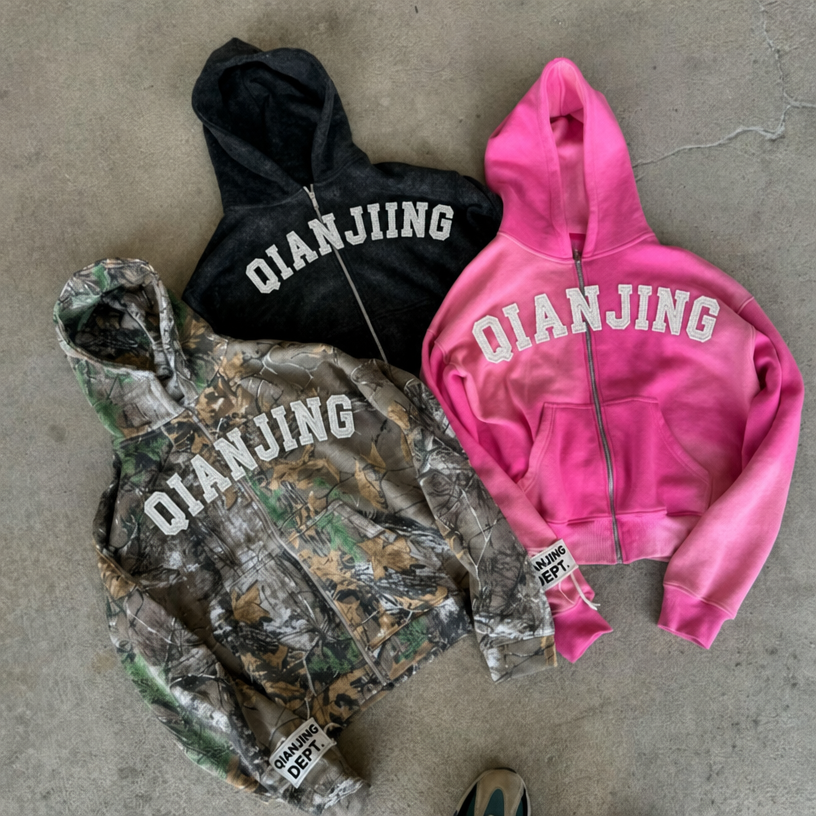
450gsm appears on the vintage full-zip hoodie blank, in 100% cotton with an oversized cut. At that weight a full-zip keeps its shape when worn open, because the body panels are heavy enough not to collapse along the zipper.
480gsm is the figure on the pre-shrunk full-zip hoodie with the camo option, also 100% cotton. Pre-shrinking is a finishing fact worth understanding rather than skimming: the fabric is treated so the garment is less exposed to length and width loss on the first wash. For a buyer printing on the chest, that matters more than for a buyer leaving the blank undecorated, since shrinkage moves the print relative to the hem.
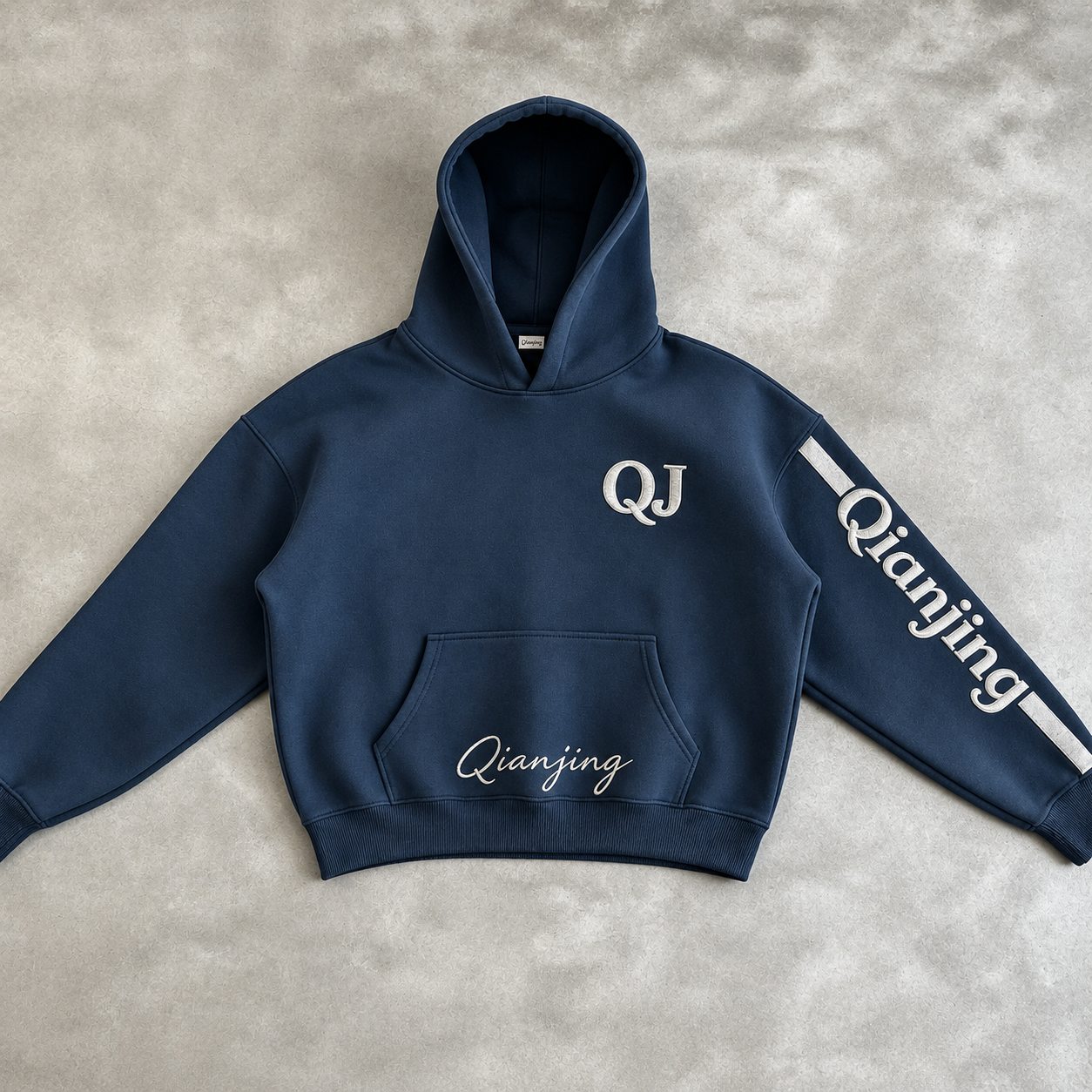
The top of the ladder is the navy oversized hooded pullover at 500gsm, in 100% soft combed cotton. Combed cotton has been run through a process that removes short fibres, which shows up as a cleaner surface — and a cleaner surface is what a screen print or embroidery build needs to sit sharply.
No crewneck weight is quoted here. Crew neck sweatshirts in a bulk program can be specified at different weights, but the right number depends on the fit and the decoration you plan, so treat the crewneck choice as a specification to set with the supplier rather than a figure to copy from this page.
Fits: oversized, drop-shoulder and baggy
Fabric weight and fit are always set together, because a heavy fabric in a tight cut reads as a different garment from the same weight in a relaxed cut. This line uses three fit directions, and each one has a buyer behind it.
- Oversized appears on both the vintage full-zip (450gsm) and the navy hooded pullover (500gsm). It is the fit most streetwear and private-label programs ask for, and it is usually specified with a dropped shoulder and a longer body.
- Drop-shoulder, baggy is the set on the French terry pullover, where the seam sits away from the shoulder point. It produces a wide silhouette without needing a larger chest measurement, which matters when a size run has to look consistent on a hanger.
- Straight or fitted cuts are what a crew neck sweatshirt bulk order often needs, since crewnecks sit under jackets and in uniform-style programs where excess fabric is a problem.
When you compare quotes from two suppliers, compare the fit label and the base measurements together. "Oversized" from one factory and "oversized" from another will not be the same pattern, so ask for the chest, body length and sleeve measurements per size rather than accepting the descriptive word.
Crewneck vs hooded pullover vs full zip
These three constructions open different decoration areas, different layering uses and different pattern routes, and a buyer who treats them as one product with optional parts will mis-specify the order.
| Construction | Verified in this line | Decoration surface | Typical buyer decision |
|---|---|---|---|
| Full zip | Vintage 450gsm, oversized; 480gsm pre-shrunk with camo option | Chest, back, sleeve; zipper tape and hood are separate print areas | Wants garment worn open, layered over a tee |
| Hooded pullover | Navy 500gsm oversized, combed cotton; white French terry pullover (hooded collar, no zipper) | Large back panel, hood, chest | Wants a single heavy piece with a hood as the feature |
| Crewneck | Specified to order — no verified weight listed here | Small chest logo, back print, sleeve | Wants a low-profile layer under outerwear |
The zipper is the deciding line for a lot of programs. A full-zip gives you two print zones either side of the zip, which limits a wide front design but allows sleeve and back work. The verified full-zips here also carry the option of a custom logo or pattern, and the 480gsm version has a camo option — a camo print changes the blank's own surface, so decide early whether the camo is part of your artwork or part of the blank you receive.
The hooded pullover has no zip opening in the French terry version, which is explicitly stated as no zipper on the product page. That makes the back panel the main canvas and keeps the front seam-free, which is the right shape for a large single-image print.
Crewnecks sit outside the listed weight set, and the honest position is that the fit, weight and decoration choice genuinely differ from hooded and zip styles. A crew neck sweatshirt bulk order usually carries a smaller decoration footprint, sits closer under a jacket and is specified by a different set of measurements. If your program is crewneck-led, the useful step is to state the fit you need, the decoration area and the weight you are targeting, and have the supplier match the pattern to it.
Branding-ready blank vs fully blank shipment
This is the part of the specification that buyers most often leave loose, and it changes what arrives at your warehouse. The vintage full-zip blank is the clearest example in this line: it can ship as a plain blank with only your tags attached, with no logo or pattern applied. That is a branding-ready shipment — the garment is unbranded on the surface but carries your label, so it can go straight to retail or straight to a decorator without a separate tagging step.
On the same garment, a custom logo or pattern is optional. So the range runs from a fully blank shipment, where nothing on the garment is yours, through a tagging-only shipment, up to an applied-logo or all-over pattern shipment. Each stage adds work, and each stage should be written into the order rather than negotiated later.
| Shipment format | What the buyer receives | Who completes the garment |
|---|---|---|
| Fully blank | Unbranded garment, no tags | Buyer or their decorator |
| Branding-ready blank | Plain garment with buyer's tags attached | Supplier attaches tags; buyer sells or decorates |
| Logo or pattern applied | Garment with custom logo or pattern | Supplier completes the surface decoration |
Choose the format by asking where the last step happens. If you run your own print shop, a fully blank shipment is the cleaner input. If you sell to a retailer that needs a shelf-ready label, tagging-only removes a handling stage. Note that tagging-only is only the verified option on the vintage full-zip blank described here; the other blanks should be specified against the same question — tags or no tags — rather than assumed to match.
Total weight per piece and how it affects decoration
Heavier fabric carries more total weight per unit, and that shows up in packing counts and shipping estimates rather than in the garment itself. At 500gsm a pullover is roughly a quarter heavier per square metre than the same pattern at 400g, so a carton count built for the French terry pullover at 400g will not hold for the 500gsm option. Set the weight first, then confirm the packing quantity that goes with it.
Decoration is the second place weight matters. A 400g French terry loop face takes some ink types differently from the combed cotton surface at 500gsm. This is not a claim about which one prints better — it is a reason to send the same test print or embroidery strike-off to your supplier on the exact weight and surface you plan to order, rather than approving artwork on a different blank.
Pre-shrinking on the 480gsm zip is the one specification in this line that directly relates to decoration placement after washing, and it is worth naming explicitly in your order notes alongside the camo option, so the two are treated as separate decisions.
Where blank programs get mis-specified
Four failures account for most of the gap between a blank quote and the delivered garment. Each maps to one of the decisions above.
- Weight and fit quoted separately. An oversized cut at 450gsm and an oversized cut at 500gsm are different garments; keep the pair together in every table and every order line.
- Construction treated as decoration. The zip, hood and no-zipper choices decide where a print can go. Confirm the print area per construction before you build artwork.
- Tagging assumed. A fully blank shipment and a branding-ready blank are not the same product. State the format and the tag placement.
- Crewneck specified from hoodie numbers. Crew neck sweatshirts need their own weight, fit and decoration decision, and the crewneck bulk order should carry those values on its own line.
Reading a quote against this checklist takes ten minutes and removes most of the back-and-forth that follows a loose specification.
Questions buyers ask before a blank order
Is 450gsm or 500gsm better for a private-label hoodie?
Neither is better on its own. The verified 450gsm full-zip is oversized and keeps its shape worn open; the 500gsm navy pullover is combed cotton, oversized and heavy by design. Pick by the construction and the hand-feel you want, then check the packing count for the weight you chose.
Can a blank ship with our tags already attached?
Yes, on the vintage full-zip blank in this line, which can ship as a plain blank with only the buyer's tags attached and no logo or pattern. State this in the order so it is not treated as an add-on.
What weight should a crew neck sweatshirt bulk order use?
Crewnecks are specified to order here, and no crewneck weight is verified on this page. Give your supplier the fit, the decoration area and the target weight, and match the pattern to it.
Does the 480gsm zip come with camo as standard?
Camo is an option on the 480gsm pre-shrunk full-zip, not part of the base blank. Decide whether the camo is your artwork or the surface you are buying, and keep it as a separate order line.
Work through the four decisions in order — weight, fit, construction, shipment format — and the rest of the blank program follows. The blanks described here are listed at the vintage full-zip blank, the 500gsm navy pullover, the 480gsm pre-shrunk zip and the white French terry drop-shoulder pullover, all at MOQ 30 pieces.